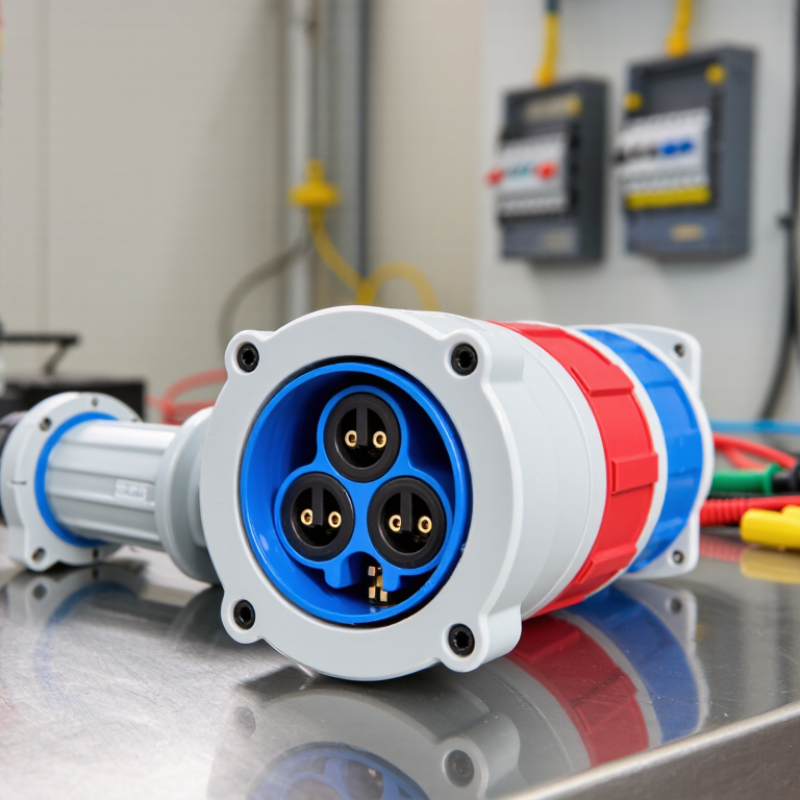
| Electrical Supply | Three-phase AC power | 380–415 V line-to-line; 50 Hz is common in China and many international markets | Three alternating currents are separated by approximately 120 electrical degrees, providing smoother power delivery for motors and balanced loads. | Confirm the local grid voltage, frequency, phase sequence, and installation regulations before ordering. |
| Rated Current | Industrial socket ratings | 16 A, 32 A, 63 A, or 125 A | The rated current indicates the continuous current the socket and plug are designed to carry under specified operating conditions. | Choose a rating equal to or higher than the protected circuit load. Do not use a higher-rated socket to compensate for undersized cables or protection devices. |
| Number of Contacts | 3P+E or 3P+N+E | 3P+E: three phases plus protective earth; 3P+N+E: three phases, neutral, and protective earth | The three phase contacts supply three-phase loads. The neutral contact supports line-to-neutral loads, while the earth contact provides a fault-current path. | Use 3P+E for balanced three-phase equipment. Use 3P+N+E when the equipment includes single-phase circuits or requires a neutral conductor. |
| Typical Pole Configuration | Four-pole or five-pole socket | 4-pole: L1, L2, L3, PE; 5-pole: L1, L2, L3, N, PE | Correct pole configuration prevents incorrect wiring and ensures all required conductors are available at the equipment connection point. | Match the socket pole count with the equipment plug, cable, circuit breaker, and wiring diagram. |
| Voltage Coding | IEC 60309-style color and clock-position coding | Red is commonly used for industrial three-phase voltages above 50 V; 400 V applications commonly use the 6h earth-pin position | Color and clock-position systems help prevent connection of equipment to an incompatible voltage configuration. | Verify the exact voltage and clock position rather than relying on color alone, especially for export installations. |
| Ingress Protection | IP44, IP54, IP67, or similar | IP44: protection against solid objects over 1 mm and water splashes; IP67: dust-tight and protected during temporary immersion | The IP rating describes resistance to dust and water when the socket is correctly installed and any cover is properly closed. | IP44 is suitable for many sheltered industrial areas. Select IP54 or higher for dusty locations and IP67 for wet or washdown environments. |
| Housing Material | Thermoplastic or metal enclosure | Common materials include impact-resistant polyamide, rubberized elastomer, and coated metal | The enclosure protects live contacts from impact, contamination, and accidental contact while supporting mechanical durability. | Look for UV resistance, impact resistance, flame-retardant properties, and temperature suitability for the installation environment. |
| Contact Material | Copper alloy contacts | Common contact finishes include nickel-plated or silver-plated surfaces | Conductive contacts transfer current between the plug and socket. Surface plating can improve corrosion resistance and contact stability. | Check contact thickness, terminal construction, corrosion resistance, and compatibility with the expected current and duty cycle. |
| Cable Entry | Straight, angled, or panel-mounted entry | Common cable-entry systems include screw terminals, cable glands, and strain-relief clamps | A secure cable entry prevents conductor movement and reduces mechanical stress on terminals and contact points. | Confirm the allowable cable diameter, conductor cross-section, bending space, and strain-relief method. |
| Switching and Isolation | Switched or unswitched socket | Switched versions may include an integral isolator or interlock mechanism | An isolating switch can disconnect the load before the plug is removed. Interlocks can help prevent plug insertion or removal while energized. | Use a switched or interlocked design where frequent connection, maintenance, or operator safety requires local isolation. |
| Mechanical Durability | Industrial-duty construction | Typical design features include reinforced housings, locking collars, and spring-loaded covers | Mechanical features help maintain contact pressure and protect the connection during vibration, repeated plugging, and handling. | Assess expected mating cycles, impact exposure, vibration, outdoor use, and the required locking method. |
| Thermal Performance | Continuous-load capability | Actual temperature rise depends on current, ambient temperature, conductor size, terminal torque, and enclosure ventilation | Excessive heat can result from overloading, loose terminals, poor contact pressure, or inadequate cable sizing. | Select a certified current rating and install conductors and protective devices according to the applicable electrical code. |
| Standards and Compliance | Industrial plug and socket standards | IEC 60309-1 and IEC 60309-2 are widely used references for industrial plugs, socket-outlets, and couplers | Standards define important requirements such as dimensions, contact arrangements, voltage identification, temperature limits, and testing. | Request current test reports, conformity documentation, dimensional drawings, and traceable product specifications for the target market. |
| Best Overall Choice | Heavy-duty three-phase industrial socket | 400 V, 16–32 A for general equipment; 63–125 A for higher-power machinery; IP44 or higher depending on the environment | A suitable socket combines correct electrical configuration, adequate current capacity, environmental protection, secure cable termination, and recognized compliance documentation. | For most industrial applications, prioritize correct 3P+E or 3P+N+E configuration, suitable IP rating, certified construction, reliable terminals, and compatibility with the complete power system. |