7 Best Ammonium Sulfate Nitrogen Fertilizers for Buyers

Choosing among the 7 Best Ammonium Sulfate Nitrogen Fertilizers for Buyers starts with a simple question: what does your soil actually need? Ammonium sulfate commonly supplies nitrogen and sulfur, but nutrient percentages and physical form can vary by product. Some grades are fine and dissolve quickly; others arrive as larger, easier-to-handle granules. Check the guaranteed analysis on the label rather than relying on a familiar product name. Small differences matter.

This guide compares options through practical buying criteria: nutrient content, granule consistency, packaging, availability, and clear product documentation. It also explains where each type may fit, from field application to smaller-scale use, without treating any fertilizer as a universal answer. A soil test can help identify nitrogen or sulfur needs, while local crop guidance can inform application timing and rates. Follow the product label, and consider runoff risk near drains or waterways. That detail is easy to overlook.

Price matters, of course. So does reliable supply. Yet the lowest-cost bag may not offer the best value if it is dusty, difficult to spread, or poorly documented. This is not a perfect ranking; product quality and suitability can change by region and season. Use the comparisons as a starting point, then verify current specifications with the supplier. A careful check beats guesswork.
7 Best Ammonium Sulfate Nitrogen Fertilizers for Buyers

What Ammonium Sulfate Fertilizer Is and How It Works

Ammonium sulfate is a water-soluble nitrogen fertilizer that also supplies sulfur. Commercial grades commonly contain about 21% nitrogen and 24% sulfur, though labels can vary. Its nitrogen is in ammonium form, which plant roots can absorb. Soil microbes may also convert it to nitrate over time. This matters because sandy soils can lose nitrate more readily after heavy rain. The sulfur supports protein formation and can help crops where soil tests show a deficiency.

It works quickly once dissolved in moist soil, but the right rate depends on the crop, soil, and existing nutrient levels. A soil test is more useful than guessing from leaf color alone. Too much nitrogen can encourage leafy growth while delaying fruit or grain development. Take care near seedlings; concentrated fertilizer against roots may cause injury.

I would also watch soil pH over repeated applications. Nitrification can gradually acidify soil, especially where buffering capacity is low. That effect is not identical everywhere. A field with clay-rich soil may respond differently from a sandy garden bed. Apply according to the product label, keep granules off foliage, and water them into the root zone when conditions are dry. Short checks help. Look for uneven growth, salt crusts, or changing soil-test results before adjusting the next application.

Key Benefits and Common Agricultural Uses

Ammonium sulfate supplies nitrogen for leafy growth and sulfur for protein formation. Typical grades contain about 21% nitrogen and 24% sulfur, but check the product label before calculating application rates. The fertilizer dissolves readily, making nutrients available when moisture is present. It can suit crops with notable sulfur needs, including canola, corn, onions, and some forage crops. Not every field needs it. Because ammonium sulfate can acidify soil over time, repeated use deserves attention, especially where soil is already acidic.

Tips: Test soil before applying. Match the rate to crop needs and expected nutrient removal. Keep granules away from direct contact with seeds, which may be harmed by concentrated fertilizer salts. Small details matter.

In practice, growers often use ammonium sulfate where both nitrogen and sulfur are needed, or where nitrogen alone would not address a sulfur deficiency. It may also fit some alkaline-soil programs, but soil conditions vary, and it is not a substitute for a full fertility plan. A common mistake is choosing it by habit. Review field history, soil-test results, and crop stage; otherwise, the added sulfur may offer little benefit while acidity gradually increases.

How to Choose an Ammonium Sulfate Fertilizer

Choosing an ammonium sulfate fertilizer starts with the crop and the soil, not the bag price. The product commonly supplies about 21% nitrogen and 24% sulfur, but check the guaranteed analysis on the label. A soil test can show whether sulfur is needed and whether the field is already acidic. This matters. Ammonium sulfate can lower soil pH over time, so repeated applications may not suit every field. Match the rate to crop needs and local recommendations, rather than treating a familiar rate as universal.

Then compare granule size, moisture, and consistency. Uniform, dry granules usually spread more evenly through a fertilizer applicator; dusty or damp material can bridge in the hopper. Ask for a current product analysis and handling guidance, especially when buying in bulk. Consider whether the fertilizer will be blended with other products, and confirm compatibility before mixing. I sometimes find buyers focus too heavily on nitrogen cost per ton. That figure can hide transport, spreading, and soil-management costs. A modest price difference may matter less than reliable analysis and predictable application.

7 Best Ammonium Sulfate Nitrogen Fertilizers for Buyers — How to Choose an Ammonium Sulfate Fertilizer
Option Fertilizer Type Typical Nutrient Analysis Physical Form Best Suited For What Buyers Should Check
1 Standard agricultural-grade ammonium sulfate Commonly labeled 21-0-0-24S: about 21% nitrogen and 24% sulfur Granules or crystals General field use when both nitrogen and sulfur are needed Confirm the guaranteed analysis, particle-size range, moisture condition, and suitability for the intended spreading equipment.
2 Coarse or compacted granular ammonium sulfate Usually close to 21-0-0-24S; verify the product label Larger, denser granules Mechanical spreading and applications where more uniform particle sizing is useful Check granule strength, size consistency, and whether the spreader can distribute the product evenly at the planned width.
3 Crystalline, water-soluble ammonium sulfate Commonly around 21% nitrogen and 24% sulfur Crystals that dissolve in water Fertigation or other approved applications requiring a soluble nitrogen-and-sulfur source Check the label for the intended application method, dissolution guidance, and compatibility with the water and other materials in the system.
4 Fine crystalline or powder ammonium sulfate Typically near the standard ammonium sulfate analysis; confirm the guaranteed values Fine crystals or powder Uses that require a fine material and where dust can be safely managed Assess dust control, storage conditions, handling equipment, and the risk of caking during storage.
5 Low-dust granulated ammonium sulfate Often marketed near 21-0-0-24S; confirm the product specification Granules processed to reduce fines Bulk handling and spreading where reduced dust and fewer fines are priorities Request the particle-size and dust specifications; “low-dust” is a handling characteristic, not a separate nutrient guarantee.
6 By-product or recovered-source agricultural ammonium sulfate May be approximately 20–21% nitrogen and 23–24% sulfur, but composition can vary Granules, crystals, or other forms depending on processing Buyers comparing recovered-source materials and conventional fertilizer on delivered cost Review a current certificate of analysis, nutrient guarantees, impurity limits, applicable regulatory requirements, and lot-to-lot consistency.
7 Ammonium-sulfate-containing fertilizer blend Variable; the nitrogen and sulfur content depends on the full blend formulation Blended granules or other labeled forms Situations where additional declared nutrients are needed alongside ammonium sulfate Read the complete guaranteed analysis, check each nutrient source and application rate, and confirm that the blend matches the soil-test recommendation.

Buyer note: Nutrient values are typical examples, not substitutes for the product label or a current certificate of analysis. Ammonium sulfate can contribute to soil acidification over time; consider soil pH, crop needs, and local agronomic advice when selecting an application rate.

Seven Ammonium Sulfate Fertilizers Compared for Buyers

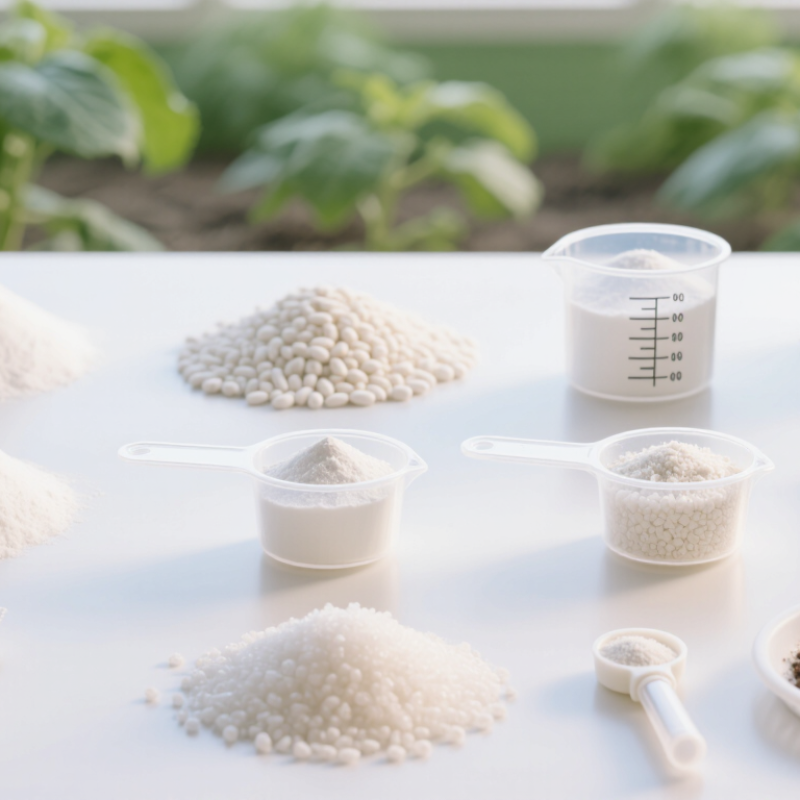
Seven ammonium sulfate products often differ more in physical form than in core nutrients. Standard granules suit broadcast spreading and are easier to handle than fine powder. Prills are generally small and rounded, while crystalline material dissolves readily but may absorb moisture during storage. Fine powder can mix quickly into blends, yet it may create more dust. Most conventional grades supply about 21% nitrogen and 24% sulfur; check the product label, since analyses can vary.

Water-soluble grade is useful for suitable fertigation systems, provided the label confirms compatibility and the equipment can manage the solution. Low-dust granules may be preferable for enclosed storage or frequent handling, though “low dust” does not mean dust-free. Bulk-blended ammonium sulfate can fit a planned nutrient program, but inspect blend uniformity and particle size to reduce segregation. These are not seven different nutrient formulas. They are practical options with different handling needs.

Tips: Match particle size to your spreader and the other blend ingredients. Review a recent soil test before choosing a rate; ammonium sulfate adds sulfur and can acidify soil over time. Store bags dry and sealed. I would not choose by price alone—cheap material that bridges in a hopper can waste a workday.

Application, Handling, and Storage Best Practices

Before spreading ammonium sulfate, check a recent soil test and the crop’s nutrient plan. The right rate depends on soil conditions, crop demand, and other nitrogen sources. Calibrate the spreader over a tarp, then inspect the pattern for gaps or heavy bands. A short test run helps. Apply on a calm day, keeping granules away from drains, ditches, and surface water. Follow product directions and local agronomic guidance; more fertilizer is not automatically better.

During loading, wear gloves and eye protection, and avoid breathing dust. Work upwind when pouring, and wash exposed skin before eating or drinking. Keep bags closed between uses. Dust still travels. If material spills, sweep or collect it gently rather than hosing it toward a drain. Check the safety data sheet for site-specific protective equipment and cleanup instructions.

Store fertilizer in its original, clearly identified packaging in a dry, covered, well-ventilated place. Raise bags on pallets, away from damp floors, roof leaks, and direct contact with walls. Keep the storage area orderly and separate the product from incompatible materials as directed by the safety data sheet. Inspect after rain. A few hardened lumps may signal moisture entry, not simply age; review storage conditions before the next delivery.

Contact us

Please fill out the enquiry form, and our dedicated team will promptly attend to your request