How to Buy Reinforcing Steel Bars for Global Projects?
Buying reinforcing steel bars for a global project requires more than comparing prices per tonne. It demands controlled verification from the mill to the construction site. The World Steel Association’s October 2024 Short Range Outlook projected global steel demand at about 1.77 billion tonnes in 2025, showing the scale and competition of the market. Meanwhile, the OECD Steel Outlook 2024 warned that global excess steel capacity could approach 630 million tonnes by 2026. These figures suggest opportunity, but they also highlight risks involving quality, origin, availability, and unstable quotations.
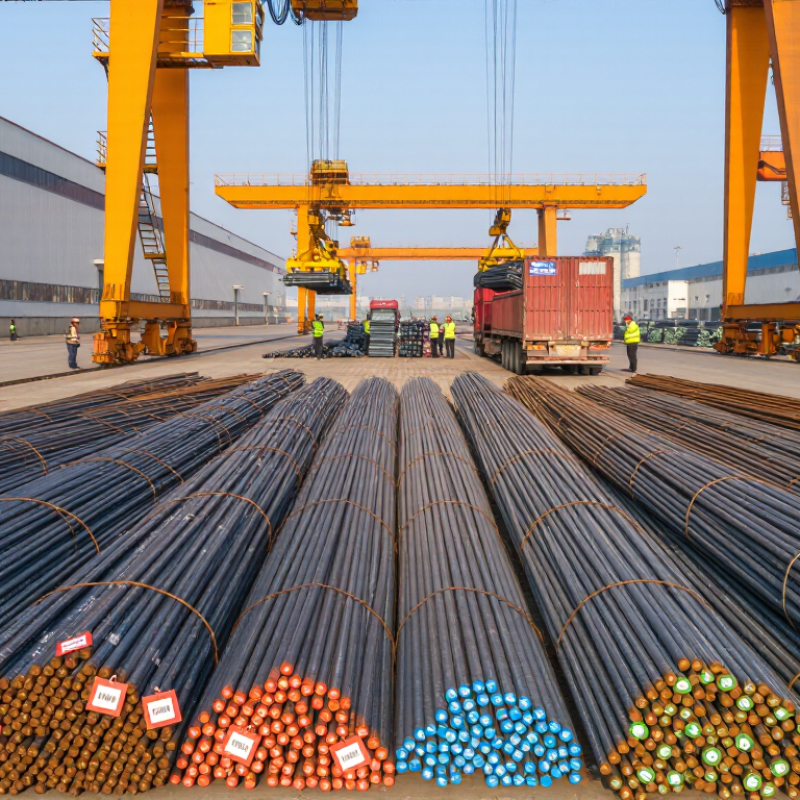
A reliable purchasing process starts with the project’s design code and exposure conditions. Confirm whether the reinforcement must comply with ASTM A615, BS 4449, EN 10080, or another specified standard. Request mill test certificates, heat numbers, chemical composition, yield strength, tensile strength, elongation, and bend-test results. For welded reinforcement, review carbon equivalent and welding procedures carefully. A bundle should carry durable tags showing size, grade, heat number, weight, and manufacturer. Small details matter. Price is not proof.
Experienced buyers should also assess production capacity, inspection systems, export packaging, shipping routes, and payment safeguards. The UNCTAD Review of Maritime Transport 2024 documented continuing disruptions and freight uncertainty, which can affect delivery schedules and landed cost. Compare offers using total delivered cost, not only the mill quotation. Include inspection, port handling, insurance, duties, storage, and possible delay exposure. No checklist is perfect. A second technical review can still reveal mismatched standards, incomplete certificates, or unrealistic tolerances before thousands of tonnes leave the port. Reliable procurement combines documented evidence, independent inspection, and practical judgment.
Set the Specification: ASTM A615 Grade 60 Requires 420 MPa Yield Strength
For global projects, define the reinforcing bar specification before requesting quotations. ASTM A615 Grade 60 requires a minimum yield strength of 420 MPa, or 60 ksi. This value is not an approximate target. It must appear clearly in the purchase specification and inspection plan. The standard also sets a minimum tensile strength of 550 MPa, or 80 ksi. Confirm the required bar diameters, lengths, surface condition, bending shapes, and applicable ASTM edition.
Request heat-specific mill test certificates for every shipment. Check the heat number, bar size, chemical results, yield strength, tensile strength, elongation, and bend-test results. The heat number must match the tags and markings on the bundles. Independent testing can verify random samples before loading or after arrival. A small mismatch may delay installation. It should not be ignored.
Grade 60 is strong, but strength alone does not prove suitability. Review the project’s welding requirements, because ASTM A615 bars may need additional controls for welding. Confirm whether the engineer requires a weldable grade or supplementary chemical limits. Protect bars from mud, saltwater, and standing water during storage. Light surface rust may be acceptable, but deep pitting reduces confidence. Specifications often look complete on paper. Field conditions can expose their weak points.
Match Global Standards: Compare BS 4449 B500B and ISO 6935-2 Grades
Buying reinforcing steel for global projects starts with matching the correct grade, not only the diameter. BS 4449 B500B specifies a characteristic yield strength of 500 MPa, a minimum tensile-to-yield ratio of 1.08, and at least 5% total elongation at maximum force. ISO 6935-2 also includes B500B, creating useful alignment. The numbers look similar.
They are not automatically interchangeable. BS 4449 and ISO 6935-2 can differ in test procedures, rib geometry, dimensional tolerances, and documentation requirements. Check the project specification, not just the grade name. Request heat numbers, chemical analysis, tensile results, bend tests, and an EN 10204 3.1 inspection certificate. Carbon equivalent matters when site welding is expected. A low-carbon bar may still require a qualified welding procedure.
A practical comparison should record yield strength, tensile strength, elongation, mass tolerance, and rib performance in one table. World Steel Association’s World Steel in Figures 2024 reported approximately 1.89 billion tonnes of crude steel production in 2023. Such scale increases supply options, but also increases traceability risks across borders. I have seen procurement teams accept a familiar certificate too quickly. That assumption is risky. Confirm the issuing laboratory, sampling method, standard edition, and test date. Also verify whether “B500B” means certified compliance or only a supplier’s commercial description. Small wording differences can create expensive re-testing at the project site.
Forecast Quantity: Schedule 6–40 mm Bars, Cut Lengths, and Splice Waste
For global projects, forecast reinforcing steel from the bar schedule, not from floor area alone. List every diameter from 6–40 mm, required grade, shape, quantity, and cut length. A 12 mm bar at 9,600 mm is not interchangeable with a 12 mm bar at 6,000 mm. My early schedules were too optimistic because they ignored transport bundles and site corrections.
Build the forecast in three layers: theoretical steel, splice allowance, and cutting waste. For example, a 1,000-tonne takeoff might carry 2% for lap splices and 1.5% for cutting loss, creating a 1,035-tonne purchasing forecast. These percentages are planning assumptions, not universal rules. Lap lengths must follow the approved structural design, concrete strength, bar grade, and applicable code. A spreadsheet can calculate mass accurately. It cannot predict every congested beam.
Keep a separate schedule for 6–12 mm distribution bars, 16–25 mm main bars, and 28–40 mm heavily loaded bars. Record stock length, required cut length, splice location, and leftover length. Pairing 5,800 mm and 4,200 mm cuts from a 12,000 mm stock bar can reduce offcuts, but only when the bending schedule permits it. The World Steel Association reported 1.89 billion tonnes of crude steel production in 2023, showing the scale of global supply, yet local availability still changes procurement timing. UNEP’s 2023 buildings report also highlights construction’s significant material and emissions burden, so waste deserves a measured allowance, not a guess.
How to Buy Reinforcing Steel Bars for Global Projects? - Forecast Quantity: Schedule 6–40 mm Bars, Cut Lengths, and Splice Waste
Preliminary procurement schedule for a reinforced-concrete construction package. Quantities are planning values based on nominal bar mass, cut-length requirements, fabrication allowance, and splice waste.
Bar Diameter
(mm) | Typical Application | Planned Installation
Week | Standard Stock
Length (m) | Average Cut
Length (m) | Required Cut
Pieces | Cut Length
Demand (m) | Splice / Fabrication
Waste | Gross Procurement
Length (m) | Estimated Stock
Bars Required | Nominal Mass
(kg/m) | Forecast Quantity
(metric tonnes) |
| 6 | Slab distribution reinforcement | Weeks 4–8 | 12 | 3.0 | 4,200 | 12,600 | 3% | 12,978 | 1,082 | 0.222 | 2.88 |
| 8 | Stirrups and slab reinforcement | Weeks 6–12 | 12 | 4.0 | 6,800 | 27,200 | 4% | 28,288 | 2,358 | 0.395 | 11.17 |
| 10 | Walls and secondary beams | Weeks 8–16 | 12 | 6.0 | 5,200 | 31,200 | 4% | 32,448 | 2,704 | 0.617 | 20.02 |
| 12 | Slab main reinforcement | Weeks 10–18 | 12 | 6.0 | 7,400 | 44,400 | 5% | 46,620 | 3,885 | 0.888 | 41.40 |
| 16 | Beam and wall reinforcement | Weeks 12–22 | 12 | 9.0 | 6,100 | 54,900 | 5% | 57,645 | 4,804 | 1.580 | 91.08 |
| 20 | Heavy beam and column bars | Weeks 16–28 | 12 | 12.0 | 4,900 | 58,800 | 6% | 62,328 | 5,194 | 2.470 | 153.95 |
| 25 | Column and transfer-beam bars | Weeks 20–32 | 12 | 9.0 | 2,800 | 25,200 | 7% | 26,964 | 2,247 | 3.858 | 104.03 |
| 32 | Core walls and major columns | Weeks 24–38 | 12 | 12.0 | 1,800 | 21,600 | 8% | 23,328 | 1,944 | 6.321 | 147.45 |
| 40 | Foundation and high-load columns | Weeks 30–40 | 12 | 12.0 | 900 | 10,800 | 8% | 11,664 | 972 | 9.877 | 115.20 |
| Total Forecast Requirement | 40,100 | 286,700 | 5.6% Weighted Average | 302,263 | 25,190 | — | 687.18 |
Planning notes: Nominal mass is calculated using the standard approximation d² ÷ 162, where d is the bar diameter in millimetres. Estimated stock bars are calculated by dividing gross procurement length by the applicable stock length and rounding up. Final purchase quantities should be reconciled with approved bar-bending schedules, lap lengths, coupler requirements, local tolerances, and project-specific cutting optimization.
