How to Choose a China Stamping Press Supplier?
Choosing a China Stamping Press supplier requires more than comparing online prices. The right partner must understand your material, production volume, part geometry, and safety requirements. A press that looks powerful on paper may still perform poorly in daily production.
Experienced buyers inspect the supplier’s engineering process, not only its showroom. Ask for machine specifications, load diagrams, cycle-time data, and sample parts made from similar steel. Factory visits can reveal practical details, such as assembly cleanliness, testing procedures, and spare-parts storage. Request references from customers with comparable applications. Their feedback often exposes delays that brochures never mention.
Technical reliability matters. Review frame construction, slide guidance, clutch systems, controls, guarding, and emergency-stop functions. Confirm whether the equipment meets applicable local standards and workplace safety expectations. Certifications should be verifiable, not simply displayed as scanned images. Discuss installation, operator training, preventive maintenance, warranty coverage, and response times before signing a contract.
Price is only one part of ownership. Energy use, tooling compatibility, downtime, shipping, and service availability can change the final cost significantly. A detailed quotation should identify every inclusion and exclusion. No checklist is perfect. Even careful buyers may overlook communication problems or unclear responsibilities. That is why written specifications, factory acceptance testing, and staged payments can reduce avoidable risk. A trustworthy China Stamping Press supplier will answer difficult questions clearly, admit limitations, and support the machine after delivery. The goal is not merely to purchase equipment, but to build a dependable production relationship.
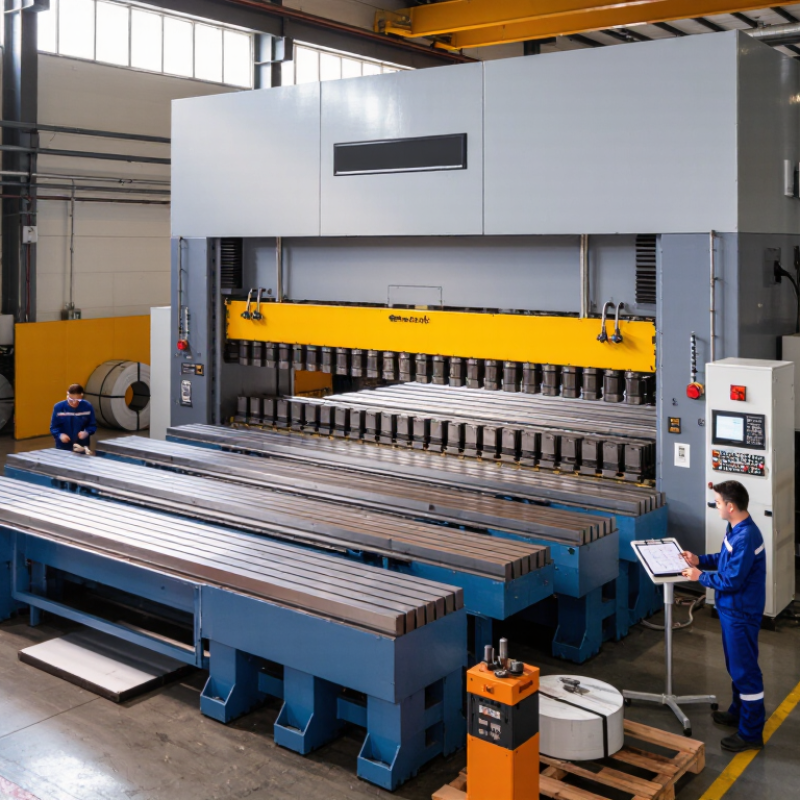
Define Your China Stamping Press Requirements and Production Goals
Choosing a China stamping press supplier starts with a production brief, not a catalog. Define material grade, thickness, blank size, part geometry, tolerance, stroke rate, and annual volume. A 160-ton press may fail when deep drawing requires more energy or a longer stroke. Record the actual load curve. Nominal tonnage is not enough.
Set measurable production goals before contacting suppliers. Include strokes per minute, uptime, scrap rate, die-change time, energy per part, and operator intervention. The International Federation of Robotics reported 541,302 industrial robots installed worldwide in 2023, with Asia representing 74% of deployments. This supports practical questions about feeders, sensors, transfer systems, and PLC communication. Your supplier should explain how the press will connect with existing equipment.
Energy deserves attention. The International Energy Agency’s Energy Efficiency 2023 report states that industry consumed about 37% of global final energy in 2022. Request motor efficiency data and energy measurements under realistic loads. Ask for sample-part trials, factory acceptance testing, maintenance schedules, and spare-parts lead times. ISO 9001 certification helps, but it does not prove press performance. A perfect spreadsheet still misses production reality. Die mass, coil width, noise, and changeover habits can alter the result. Recheck your assumptions before signing; early specifications are often incomplete.
How to Choose a China Stamping Press Supplier? - Define Your China Stamping Press Requirements and Production Goals
| Requirement Dimension | Typical Requirement Range | Recommended Supplier Capability | Production Goal | Verification Method |
|---|---|---|---|---|
| Material Type | Carbon steel, stainless steel, aluminum, copper, or coated sheet | Experience with the required material grade, thickness, hardness, and surface finish | Stable forming performance with minimal cracking, galling, or surface damage | Review material certificates, sample parts, and trial-production results |
| Material Thickness | Approximately 0.3–6.0 mm, depending on the application | Press capacity, frame rigidity, and tooling support suitable for the thickness range | Consistent part dimensions throughout the production batch | Compare the machine specification with the calculated forming and blanking force |
| Part Size and Geometry | Small precision parts to large panels, based on die dimensions | Adequate bed size, slide dimensions, shut height, and stroke length | Complete forming without interference, wrinkling, or excessive scrap | Submit 2D drawings, 3D files, die layouts, and clearance requirements |
| Required Press Capacity | Common mechanical press range: 25–1,000 metric tons | Rated capacity with a safety margin above the calculated peak force | Avoid overload, premature wear, and unstable forming conditions | Request force calculations and confirm the rated tonnage at the specified shut height |
| Press Type | Mechanical, hydraulic, servo, or tandem configuration | Ability to match press type with speed, control, forming depth, and flexibility needs | Balance productivity, control accuracy, energy use, and investment cost | Compare cycle requirements, force curves, operating modes, and sample results |
| Production Volume | Prototype, 1,000–10,000 parts/month, or over 100,000 parts/month | Scalable equipment, spare parts availability, and documented maintenance support | Meet demand without excessive idle time or premature capacity expansion | Calculate required strokes per minute, working hours, uptime, and changeover time |
| Target Production Speed | Approximately 20–120 strokes per minute for many mechanical applications | Stable operation at the required speed with suitable lubrication and feeder integration | Increase output while maintaining part quality and operator safety | Conduct a continuous-speed test using the intended material and tooling |
| Dimensional Accuracy | Typical tolerance may range from ±0.05 mm to ±0.30 mm, depending on part design | Rigid frame, controlled slide guidance, accurate die alignment, and inspection capability | Reduce rework, assembly problems, and customer rejection rates | Use calibrated gauges, coordinate measurement, and capability studies where required |
| Automation Level | Manual loading, coil feeding, transfer automation, or progressive-die production | Compatible feeders, sensors, decoilers, straighteners, transfer systems, and safety controls | Lower labor input, fewer handling errors, and more consistent cycle times | Review the complete line layout, interface signals, and automatic fault-stop functions |
| Tooling Compatibility | Existing die or new die with specified dimensions and mounting requirements | Suitable bolster openings, T-slots, die clamps, shut height, and cushion options | Fast die installation and reliable repeatability between production runs | Confirm die drawings, mounting points, ejector settings, and available adjustment range |
| Safety Requirements | Guarding, emergency stops, two-hand controls, light curtains, and overload protection | Documented risk assessment and compliance support for the destination market | Protect operators and reduce unplanned downtime caused by unsafe conditions | Inspect safety circuits, guarding, stop response, manuals, and required conformity documents |
| Quality Control | Incoming inspection, in-process checks, final inspection, and traceable records | Quality plan, inspection equipment, corrective-action process, and trial-run reports | Maintain stable quality across batches and support root-cause analysis | Request inspection plans, sample reports, acceptance criteria, and nonconformance procedures |
| Energy and Operating Cost | Varies with motor power, cycle rate, duty cycle, and automation configuration | Transparent power consumption data and accessible maintenance components | Control total cost of ownership over the planned service life | Compare installed power, estimated consumption, lubrication needs, and maintenance intervals |
| Lead Time and Installation | Often 8–24 weeks, depending on customization, tooling, and inspection requirements | Clear project schedule, factory acceptance testing, packing standards, and commissioning support | Start production on schedule with minimal installation disruption | Include milestones for design approval, manufacturing, testing, shipment, and acceptance |
| After-Sales Service | Remote support, spare parts, maintenance training, and on-site service when needed | English technical documentation, response-time commitment, spare-parts list, and service process | Minimize downtime and improve long-term equipment availability | Define warranty coverage, service response time, training scope, and replacement-part lead time in the contract |

Contact us
Please fill out the enquiry form, and our dedicated team will promptly attend to your request