7 Tips for Choosing Anti Ligature LED Downlights
Safe lighting is part of a wider environmental-safety plan in behavioral-health and secure-care settings. The World Health Organization’s World Mental Health Report (2022) estimates that nearly one in eight people worldwide lived with a mental disorder in 2019. That figure does not prescribe a fixture, but it underscores the scale and diversity of care environments.
An Anti-Ligature LED Downlight must do more than fit a ceiling opening. Its shape, fixings, lens, and access method can affect how well it suits a room’s assessed risks. Staff may also need dependable illumination for observation, cleaning, and routine checks. Small details matter. A protruding trim or difficult-to-clean edge can undermine an otherwise thoughtful specification.
Professional guidance can help frame the decision. NHS Health Technical Memorandum 08-03 addresses healthcare lighting, while the Illuminating Engineering Society’s RP-29-16 covers lighting for healthcare facilities. These references support careful attention to lighting quality and clinical use; they do not certify every anti-ligature product. That distinction is easy to miss.
The seven tips that follow focus on practical checks: documented testing, construction, light output, maintenance, and compatibility with the ceiling and care setting. Ask suppliers for current test evidence and clear installation instructions. Verify claims against project requirements. No single downlight removes every risk, and product labels alone are not proof of suitability.
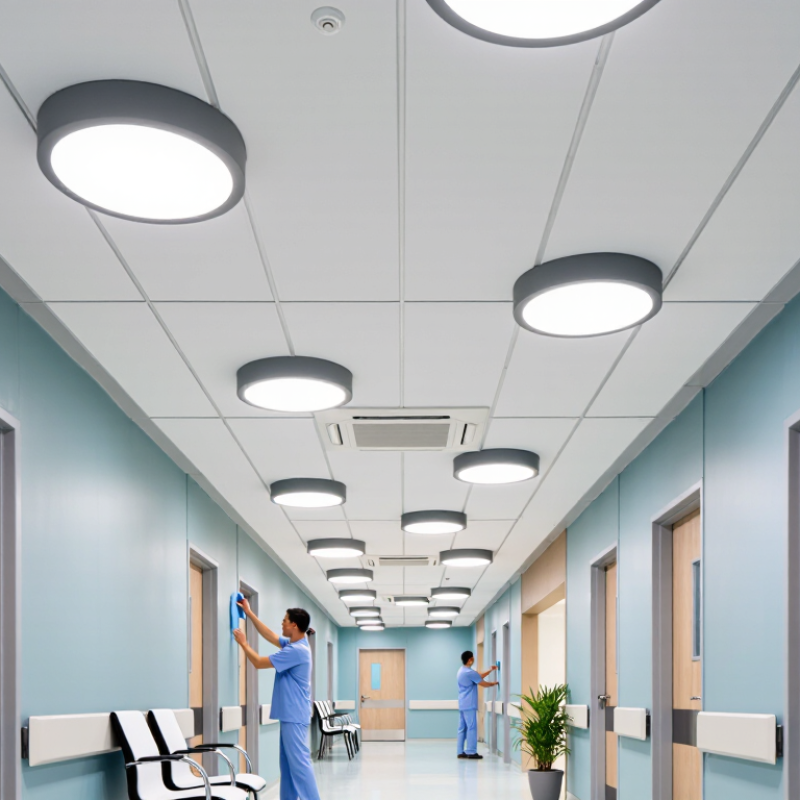
Identify Ligature Risks and Require Documented Anti-Ligature Testing
When selecting anti-ligature LED downlights, begin with a room-by-room risk review, not a product label. Check whether occupants can reach the fitting, and inspect its rim, ceiling gap, fasteners, and nearby cable routes. A narrow shadow line may look harmless but create a snag point. Small details matter. NHS Health Building Note 03-01 offers design guidance for adult acute mental health units; use it alongside a site-specific assessment, since room layouts and user needs differ.
Ask for documented anti-ligature testing before specifying a fitting. The report should identify the exact model, test method, mounting surface, load direction, results, and any limits on installation. Confirm that the tested assembly matches the actual ceiling and fixing method. A report for a different substrate is not enough. The World Health Organization’s 2024 suicide fact sheet estimates that more than 720,000 people die by suicide each year; this broad figure is not a ligature-specific statistic, but it underlines why environmental safety deserves careful review. Testing cannot replace clinical risk assessment, and paperwork can be incomplete. That is worth challenging. Have facilities, clinical, and safety teams review the evidence together, then record unresolved risks and inspection responsibilities.
Rate Impact Strength: IEC 62262 IK10 Represents 20 J of Impact
When selecting anti-ligature LED downlights, check the impact rating—not just the appearance of the fitting. Under IEC 62262, IK10 represents resistance to an impact energy of 20 joules. That rating offers a useful benchmark for areas where a light may be struck by a hard object. It does not mean the fitting is indestructible.
Look closely at what was tested. A tough lens can still be paired with a vulnerable bezel, exposed screws, or a weak mounting arrangement. Ask for test documentation that identifies the exact downlight configuration, including its cover and fixings. Confirm that the ceiling substrate and installation method match the conditions required by the manufacturer. Small differences matter.
Think about the room, too. A fitting near a doorway or low ceiling may face more frequent knocks than one mounted high in an open corridor. IK10 can support a considered specification, but it does not replace checks for ligature resistance, cleaning needs, light output, or safe installation. I would not treat the number as a complete answer; it is one piece of evidence, and sometimes the product details are less clear than they should be.
Set Task Lighting Using EN 12464-1 Illuminance and Colour-Rendering Criteria
Choose anti-ligature LED downlights by starting with the work people actually do beneath them. EN 12464-1 sets task-based criteria for maintained illuminance, uniformity, glare, and colour rendering. Check the relevant task category and current edition; one lux target does not fit every room. A reading area, for example, needs different lighting from a circulation space.
Measure illuminance on the task plane, not just at floor level. Account for the maintenance factor, ceiling height, beam spread, and dirt that can build up around fittings. Specify colour rendering to suit the task and the applicable criteria. Where staff must distinguish skin tones, labels, or small objects, poor colour rendering can make routine checks harder. The right requirement depends on the room’s use.
A bright spot on a desk is not enough. Check that light reaches the working area evenly and that the downlight does not create uncomfortable glare from beds or seated positions. In practice, a neat calculation can still miss a shadow cast by shelving or a person standing close to the task. Mock-ups help. Record lux readings after installation, under actual operating conditions, and review them against the design assumptions. Safety-rated, secure fittings matter too, but they cannot compensate for poorly planned task lighting.
| Tip | Selection focus | Criteria and practical data | What to verify |
|---|---|---|---|
| 1 | Define the task and room use | Identify each visual task, its location and the users’ needs before setting the lighting. EN 12464-1:2021 gives maintained illuminance, glare and colour-rendering requirements by activity and area; there is no single illuminance value that suits every room. | Use the applicable standard activity and area entry for the project, and document the task plane and any relevant surrounding area. |
| 2 | Set maintained illuminance, not just initial output | Specify maintained illuminance, Em, in lux at the actual task plane. The design should account for depreciation and the stated maintenance plan; initial illuminance will generally be higher than maintained illuminance. | Request a lighting calculation showing the maintained lux level, luminaire layout, assumptions and maintenance factor. Confirm results on site with a calibrated lux meter. |
| 3 | Check uniformity and glare for the task | Use the applicable EN 12464-1 uniformity requirement, expressed as U₀ = Emin / Eavg, and the applicable limiting UGR value, UGRL. Both limits depend on the activity and viewing conditions. | Review the calculation for the specified task area and viewing directions. Avoid relying on a product’s general glare claim as a substitute for a project calculation. |
| 4 | Specify colour rendering for visual accuracy | Check the colour-rendering index Ra against the requirement for the selected activity in EN 12464-1. Ra ≥ 80 is a common minimum for many indoor work areas, but some tasks require a higher value. | Obtain the manufacturer’s photometric data and confirm the stated Ra for the selected LED module. Specify a higher Ra where accurate colour judgement is important. |
| 5 | Choose colour appearance to suit the space | Correlated colour temperature (CCT), measured in kelvin, describes whether the light appears warmer or cooler. EN 12464-1 does not set one universal CCT for all applications. | Set the project CCT according to the room’s intended use, user preference and consistency with adjacent spaces. Check that replacement modules will match the installed CCT and colour consistency. |
| 6 | Assess the complete anti-ligature installation | Anti-ligature suitability depends on the luminaire, its mounting, surrounding ceiling and installation details—not the LED light source alone. A fixture description by itself does not establish suitability for every risk level. | Obtain a project-specific risk assessment and check the required fixing method, accessible edges, gaps, impact resistance and inspection or maintenance arrangements with the responsible design and safety team. |
| 7 | Confirm controls, maintenance and commissioning | Choose dimming and switching only where they support the lighting brief and are compatible with the driver and control system. Record the maintained illuminance target, operating scenes and maintenance schedule. | Check driver-control compatibility, test each scene after installation, measure illuminance at the defined task plane and retain the results for handover and future maintenance. |
Check Sealing: IEC 60529 IP65 Is Dust-Tight and Water-Jet Resistant
Anti-ligature LED downlights need more than a smooth, secure shape. Their sealing matters in washrooms, clinics, and other spaces cleaned with water. IEC 60529 IP65 means a tested enclosure is dust-tight and resists water jets from any direction. It does not mean the fitting can be submerged. A rating is useful, but only when it matches the installed product.
Tip: Check the complete luminaire’s IP rating, not just its lens or housing. Look for IP65 on the technical datasheet, and confirm that the stated rating covers cable entries, joints, and mounting parts. During installation, inspect the gasket for twists or pinches. Even a small gap can undermine the seal. Follow the manufacturer’s cleaning and installation instructions.
Water jets are not the only concern. Detergent residue, repeated cleaning, vibration, and ageing can affect seals over time. Check that the cover sits flush and that screws are secure, without overtightening them. Keep the installation record, then inspect fittings during routine maintenance. A quick visual check helps, though it cannot replace proper testing. IP65 is a clear benchmark, not a promise against every site condition.
7 Tips for Choosing Anti-Ligature LED Downlights
Check Sealing: What the IP65 Rating Means
IP65 indicates that the first digit, 6, signifies dust-tight protection, while the second digit, 5, signifies protection against water jets. These are separate test classifications; IP65 does not mean the fitting is suitable for immersion. Check that the complete fitting and its installation meet the required protection level.
Verify IEC 60598 Safety, Emergency Runtime, and L70 Service-Life Data
Anti-ligature downlights need documented safety performance, not just a reassuring product label. Ask for the IEC 60598 test report and confirm which requirements and luminaire type it covers. Check that the tested configuration matches the supplied fitting, including its trim, fixings, and enclosure. A certificate alone may not show how the light performs when installed in a particular ceiling.
Emergency runtime needs careful checking. A stated three-hour duration, for example, should be supported by test results at the specified load and operating conditions. Ask whether the figure reflects maintained light output or simply continued operation. Battery age, temperature, and charging conditions can affect performance. Small details matter. A practical handover should record test dates and make routine function checks easy for facilities staff.
L70 data describes the projected time until LED output falls to 70 percent of its initial level; it does not promise that the whole fitting will last that long. Request the test basis, ambient temperature, and operating assumptions. Compare these with the actual ceiling conditions, especially where heat can collect above a sealed surface. Check the driver’s expected life separately, since it may need replacement sooner. The numbers can look precise, but real installations are rarely perfect. Revisit the assumptions before setting maintenance intervals.
Article Source:
Contact us
Please fill out the enquiry form, and our dedicated team will promptly attend to your request