How to Choose Glass Magnesium Rock Wool Sandwich Panels?
Choosing the right Glass Magnesium Rock Wool Sandwich Panel is more than comparing prices per square metre. The decision affects fire safety, thermal performance, acoustic comfort, installation time, and long-term maintenance. The International Energy Agency reports that buildings consume about 30% of global final energy. Their emissions also remain significant. This makes insulated wall and roof systems important in industrial, commercial, and cold-storage projects.
A practical selection begins with the building’s real conditions. Measure the required U-value, indoor humidity, wind exposure, span, and expected impact. Then check the panel’s core density, magnesium board thickness, joint design, and tested fire classification. EN 13501-1 and ASTM E84 provide useful reference points, but their results are not directly interchangeable. FM Approvals Standard 4880 may also matter for specific industrial assemblies. Always request complete test reports, not only marketing summaries. Small details matter. A damaged edge can weaken moisture resistance.
Market reports also show why performance claims deserve careful review. The IEA’s building-sector analysis supports stronger energy efficiency measures, while insulation industry studies from Grand View Research and MarketsandMarkets indicate continuing demand for high-performance envelope materials. However, market growth does not prove that every panel suits every project. It only shows wider adoption. That distinction is easy to miss.
This guide explains how to compare a Glass Magnesium Rock Wool Sandwich Panel by evidence, not appearance. It considers thermal values, fire testing, moisture behavior, structural limits, supplier quality, and lifecycle cost. The cheapest quotation may look attractive. It may not remain cheap after repairs, delays, or replacement. In practice, the best choice is often the panel with the clearest documentation and the fewest unanswered questions.
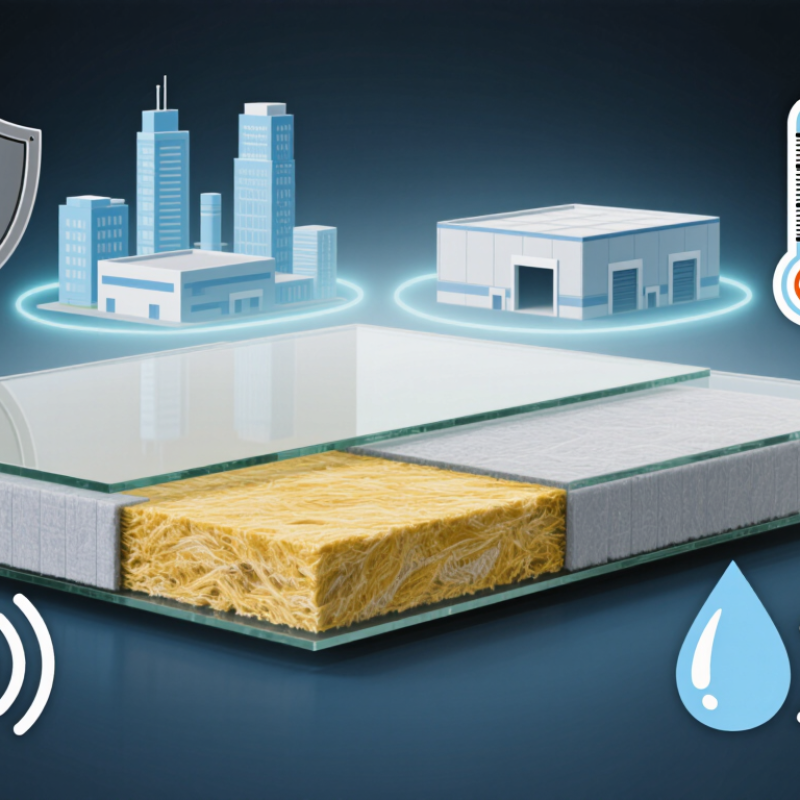
Understanding Glass Magnesium Rock Wool Sandwich Panel Structure
Choosing Glass Magnesium Rock Wool Sandwich Panels requires more than comparing thickness and price. Their structure determines fire resistance, insulation, strength, and service life. The typical panel has two glass magnesium boards surrounding a rock wool core. The boards provide a hard, moisture-resistant surface, while the mineral wool limits heat transfer and helps reduce sound.
Examine each layer closely. The glass magnesium boards should be flat, firmly bonded, and free from edge damage. The rock wool core needs consistent density without visible gaps or crushed areas. Small voids can become weak points. Check the panel thickness against the building’s thermal and fire requirements, not only the catalog specification.
Joint design also matters. Tongue-and-groove edges, sealants, and suitable fasteners help prevent air leakage and water entry. On site, cut edges should be protected before installation. In humid spaces, I would inspect storage conditions carefully, because wet insulation may lose performance before installation begins. Do not ignore panel weight. A thicker core may improve insulation but increase handling demands and structural loads.
A practical selection process includes reviewing test reports, core density, board thickness, dimensional tolerance, and installation instructions. Independent testing is more reliable than vague performance claims. One detail is easy to miss: a strong panel can still fail when joints are poorly aligned. Careful installation remains part of the panel’s real structure.
Defining Fire, Thermal, Acoustic, and Moisture Control Requirements
Choosing glass magnesium rock wool sandwich panels starts with measurable control requirements, not panel appearance. The UNEP GlobalABC 2023 report states that buildings consumed about 34% of global energy and produced roughly 37% of energy-related and process emissions. This makes thermal resistance important, but higher insulation is not automatically better. Specify the target U-value, local climate, joint design, and thermal bridges. Rock wool cores commonly report thermal conductivity near 0.035–0.045 W/m·K, although declared values vary with density and testing temperature.
Fire performance must cover the complete assembly. Under EN 13501-1, some mineral-wool-based systems can achieve A1 or A2 classifications, but facings, adhesives, coatings, and joints may change the result. Ask for tested classification reports, furnace conditions, thickness, and fixing details. A laboratory rating is not a guarantee for every installation. That distinction is often missed.
Acoustic control needs a target frequency range. ISO 10140 laboratory tests can provide sound reduction values such as Rw, yet real buildings lose performance through gaps, penetrations, and rigid connections. For moisture, follow the condensation-control principles in the ASHRAE Handbook—Fundamentals. Check vapor permeability, indoor humidity, external exposure, drainage, and edge sealing. Wet insulation performs poorly. A small unsealed joint can defeat a carefully selected core. Site inspection remains necessary, because product data rarely captures every construction mistake.
Comparing Core Density, Panel Thickness, and Insulation Performance
Choosing a glass magnesium rock wool sandwich panel starts with density, thickness, and real insulation performance. Rock wool cores commonly use densities from 80 to 150 kg/m³. Higher density can improve fire resistance, impact strength, and sound absorption. It does not automatically provide better thermal insulation. Thermal conductivity often falls near 0.034–0.040 W/m·K, depending on testing and product structure. The EN 13162 insulation standard requires declared thermal values, so compare certified data rather than marketing claims.
Thickness directly affects thermal resistance. Using 0.037 W/m·K as an example, a 100 mm core provides about 2.70 m²·K/W. A 150 mm core reaches approximately 4.05 m²·K/W. The IEA Buildings 2023 report identifies buildings as responsible for around 30% of global energy demand, making this difference significant in large envelopes. Still, joints, fixings, and compression can reduce site performance. This is where many specifications become too optimistic.
Tips: Check declared lambda, density tolerance, thickness tolerance, and tested U-value. Ask for EN 13162 results and fire-test classifications. ASHRAE Handbook—Fundamentals recommends evaluating the complete assembly, not insulation alone. A denser panel may be worth choosing near machinery or busy corridors. For a quiet warehouse, the extra cost may bring limited value. I would also inspect panel edges carefully; damaged laps can undermine excellent core insulation.
Checking Quality Standards, Supplier Credentials, Cost, and Maintenance Needs
How to Choose Glass Magnesium Rock Wool Sandwich Panels?
Quality starts with test evidence, not a shiny surface. Check the panel’s fire classification under EN 13501-1 and fire-resistance testing based on ISO 834. Ask for recent reports covering the complete panel system, including joints and fasteners. Core density, thermal conductivity, moisture absorption, and dimensional tolerance also matter. The International Energy Agency reported that buildings consume about 30% of global final energy. Better insulation can therefore reduce operating demand, but only when installation remains airtight.
Tips: Request batch numbers, production dates, and third-party laboratory reports. Verify whether the supplier holds ISO 9001 certification and permits factory audits. A reliable supplier should explain glass magnesium board composition, rock wool density, and coating performance clearly. Vague answers deserve caution. I would also compare at least three quotations, separating panel price, transport, accessories, labor, and warranty coverage. The cheapest offer may omit edge treatment or replacement stock. That mistake becomes expensive later.
Maintenance needs should be judged before purchase. Inspect panel joints, sealant lines, exposed edges, and roof penetrations at least annually. In humid buildings, look for swelling, staining, corrosion, or loose fixings. The U.S. Department of Energy notes that uncontrolled moisture can damage insulation performance and building materials. Supplier credentials help, but they do not replace site inspection. Some specifications seem excessive until the first leak appears. Then, even a small omission becomes visible.
How to Choose Glass Magnesium Rock Wool Sandwich Panels?
Use this practical evaluation model to balance quality standards, supplier credentials, total cost, and long-term maintenance needs. The weighting is an example procurement framework and should be adjusted to project requirements.
Key takeaway: Verify fire, thermal, and mechanical performance through recognized test standards before comparing prices. Confirm the supplier’s quality system, technical documentation, warranty terms, and after-sales support. A lower purchase price may result in higher installation, repair, or replacement costs.
