How to Choose a Zigbee Fan Coil Thermostat?
Choosing the right zigbee fan coil thermostat can make room control smoother, quieter, and more energy-aware. It can also create expensive problems when compatibility is overlooked. A thermostat may look modern, yet fail to operate a two-pipe fan coil unit correctly. The wiring terminals matter. So does the valve type. Before comparing models, identify the fan coil configuration, heating and cooling changeover method, and available power supply. A small label inside the control panel can reveal more than a glossy product page. Take a photo first.
Reliable selection requires practical HVAC knowledge and careful Zigbee planning. Check whether the thermostat supports your Zigbee hub, network frequency, and required communication functions. Confirm its control outputs match the fan speeds and valve actuators. Room sensors should respond steadily, not jump between 21°C and 24°C within minutes. Metal cabinets, concrete walls, and crowded wireless channels can weaken signals. Wireless is not magic. A mesh network may still need a powered router nearby. Look for clear installation instructions, firmware support, local control options, and documented safety ratings. Professional commissioning is wise when wiring is uncertain. Even experienced installers can miss a changeover setting. This guide examines the details that influence comfort, reliability, maintenance, and long-term value, helping readers choose with evidence rather than appearance alone.
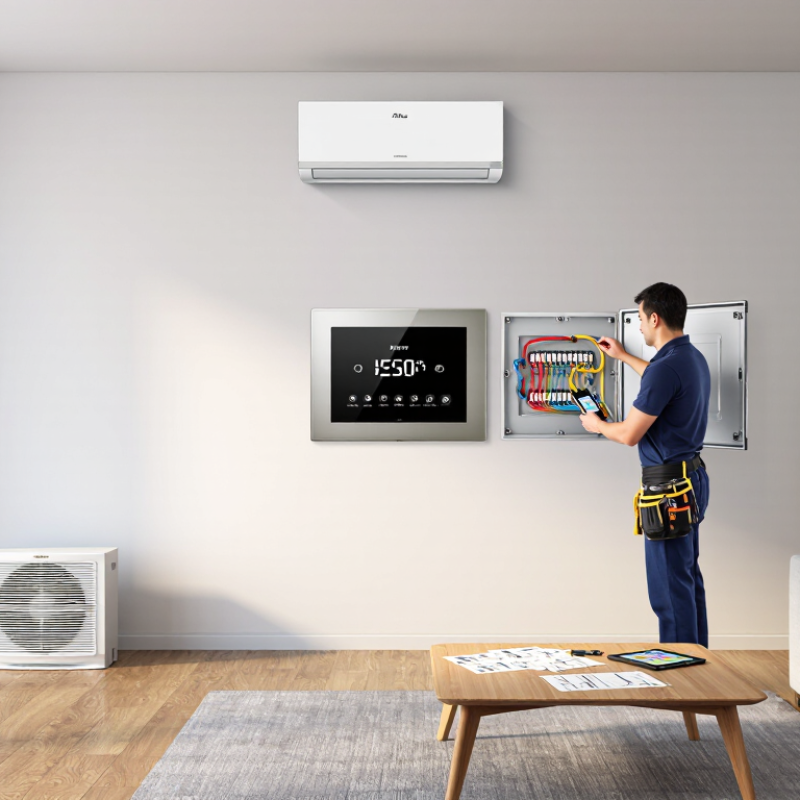
Define Zigbee Fan Coil Thermostat Functions and Compatibility
How to Choose a Zigbee Fan Coil Thermostat?
Defining functions clearly is more important than choosing a stylish wall unit. A practical thermostat should control heating, cooling, fan speed, and operating modes. Check whether it supports two-pipe or four-pipe fan coil systems. These systems use different valve arrangements. The thermostat must also match the building’s supply voltage, valve type, and wiring layout. In field installations, I always photograph terminal labels before replacing a controller. A small wiring mistake can damage equipment or create unsafe operation.
Compatibility needs closer inspection. Zigbee 3.0 support is useful, but it does not guarantee complete interoperability. Confirm the gateway, device profile, endpoint structure, and supported clusters. The thermostat should expose temperature, setpoint, mode, fan speed, and valve status clearly. Reliable reporting matters, especially when a gateway monitors several rooms. Look for secure joining, encrypted communication, and firmware update support. Ask whether local control still works during network failure. It should.
Installation conditions can reveal overlooked problems. Thick walls may weaken wireless signals. Metal cabinets can interfere with communication. A thermostat may also need a neutral wire, which older rooms often lack. Do not trust a general compatibility chart alone. Request wiring diagrams and test the actual gateway before bulk installation. I have seen technically compatible devices behave poorly because their fan-speed commands were mapped differently. A perfect checklist does not exist. Verification remains necessary.
Identify Your Fan Coil System and Wiring Requirements
How to Choose a Zigbee Fan Coil Thermostat?
Identify Your Fan Coil System and Wiring Requirements
Before choosing a Zigbee fan coil thermostat, identify the HVAC system type. Check whether it uses a two-pipe or four-pipe configuration. A two-pipe system usually switches between heating and cooling seasons. A four-pipe system can provide both functions independently.
Look closely at the wiring terminals. Record the supply voltage, fan speed wires, valve connections, and common wire. Some fan coil units use low-voltage controls. Others switch line voltage directly. This difference is critical. Zigbee communication does not guarantee electrical compatibility.
Count the fan speeds carefully. Many units use low, medium, and high settings. Some use only one or two speeds. Check whether the valve actuator needs a powered signal or a dry contact. Also confirm whether the thermostat requires a neutral wire. The wiring diagram may be faded or incomplete. Take clear photographs before disconnecting anything.
A practical check includes the existing thermostat model, terminal labels, and measured voltage. Never rely on wire colors alone. They can vary between installations. Turn off power before inspection, and ask a qualified technician to verify uncertain circuits. I have seen replacement projects fail because installers matched terminal names without checking system voltage. That mistake is easy to repeat. The thermostat should support your exact fan control method, valve logic, and Zigbee network requirements. Test pairing and manual operation after installation. Physical comfort still matters.
Compare Zigbee Features, Control Modes, and Smart Home Integration
How to Choose a Zigbee Fan Coil Thermostat?
A Zigbee fan coil thermostat should match your wiring, control modes, and home ecosystem. Zigbee 3.0 uses mesh networking, allowing devices to relay signals across rooms. The Connectivity Standards Alliance also emphasizes interoperability between certified devices. Check whether the thermostat supports two-pipe or four-pipe systems. Confirm heating, cooling, automatic, and fan-only modes. Some models offer three fan speeds, valve control, temperature calibration, and scheduling. These details matter more than a glossy screen.
Integration requires careful checking. A compatible Zigbee coordinator or gateway must recognize the thermostat’s clusters and commands. Look for encrypted communication, over-the-air updates, and local control when the internet fails. Voice assistants may need an additional platform bridge. The 2023 UNEP Global Status Report states that buildings consume about 30% of global energy. Better temperature control can reduce waste, but savings depend on insulation, occupancy, and commissioning. The device alone cannot fix poor system design.
Tips: Test the thermostat with your actual fan coil before full installation. Verify neutral-wire requirements and valve voltage. Keep a manual control option. I once saw an efficient schedule fail because the occupancy sensor faced a glass wall. That mistake was small, but costly. Also compare reporting intervals, hysteresis settings, and recovery behavior after a power cut. A quiet relay is useful. A reliable fallback is better.
Evaluate Installation, Sensors, Power Options, and User Controls
How to Choose a Zigbee Fan Coil Thermostat?
Installation details often decide whether a Zigbee fan coil thermostat performs reliably. Check the wiring diagram before purchasing. Confirm the thermostat supports your valve type, fan stages, and available voltage. Some systems need a neutral wire, while others depend on batteries or low-voltage power. Measure the wall box carefully. A crowded box can make installation awkward and unsafe.
Sensor quality matters during daily operation. A built-in temperature sensor may read inaccurately near sunlight, doors, or warm electronics. If possible, choose a model supporting a remote sensor. Place it around breathing height, away from supply air. Humidity sensing can improve comfort in damp rooms. However, extra sensors increase setup work and maintenance. More features are not always better.
Power options should match the room’s purpose. Battery power simplifies retrofits but may require seasonal replacement. Wired power offers steadier operation and supports frequent Zigbee communication. I once preferred batteries for every renovation, but that choice caused unnecessary service visits. User controls deserve equal attention. Physical buttons help guests and older users. A clear display should show temperature, fan speed, and operating mode without hidden menus. App control is useful, but local controls should still work when the network is unavailable. Test pairing, signal strength, and recovery after a power cut before final installation. Weak mesh coverage is easy to overlook.
How to Choose a Zigbee Fan Coil Thermostat? - Evaluate Installation, Sensors, Power Options, and User Controls
| Evaluation Dimension | Option A: Basic Retrofit | Option B: Balanced Specification | Option C: Advanced Installation | Selection Guidance |
|---|---|---|---|---|
| Typical application | Existing room with simple fan-coil wiring and limited control requirements. | Residential or commercial room requiring reliable heating, cooling, and fan-speed control. | Large project or smart-building installation with centralized monitoring and automation. | Match the thermostat to the fan-coil unit, valve arrangement, and building-control strategy. |
| Fan-coil system type | Two-pipe changeover system with heating or cooling available according to season. | Two-pipe or four-pipe system with separate heating and cooling control. | Four-pipe system with independent valves, occupancy logic, and multi-zone integration. | Confirm whether the system uses two-pipe or four-pipe changeover before purchasing. |
| Valve output compatibility | On/off valve output for compatible thermal or motorized valves. | Separate heating and cooling outputs, typically using relay-based switching. | Multiple valve outputs with configurable operating sequences and interlocks. | Verify voltage, current rating, normally open or normally closed operation, and actuator type. |
| Fan-speed control | Three fixed speeds: low, medium, and high. | Three speeds plus automatic fan mode based on temperature demand. | Configurable fan sequence, minimum run time, delayed shutoff, and valve-fan interlock. | Select a model with the same number of fan stages as the installed fan-coil unit. |
| Power option | Mains-powered installation using the available HVAC supply circuit. | Low-voltage power supply suitable for control panels or dedicated HVAC wiring. | Power architecture selected according to local electrical standards and project requirements. | Check supply voltage, frequency, terminal layout, electrical protection, and installation regulations. |
| Battery-powered suitability | Generally unsuitable for directly switching fan motors or multiple valve actuators. | Possible when a separate receiver or relay module handles HVAC loads. | Suitable for low-power wireless control when the field equipment provides the required switching interface. | Do not assume a battery thermostat can power a fan-coil motor directly. |
| Built-in temperature sensor | Internal room-air sensor for standard wall-mounted use. | Internal sensor with configurable calibration or temperature offset. | Internal sensor combined with external, remote, or averaged sensing. | Install away from drafts, direct sunlight, doors, windows, and heat-producing equipment. |
| External sensor support | Usually not required for ordinary rooms. | Useful for concealed fan-coil units or locations where wall temperature is inaccurate. | Supports remote room, duct, floor, or changeover sensors when compatible with the controller. | Confirm sensor resistance range, cable length, placement, and whether the sensor is included. |
| Humidity and air-quality sensing | Not necessary for basic temperature control. | Optional humidity measurement for comfort monitoring. | Optional humidity, carbon-dioxide, or air-quality data for ventilation and building automation. | Choose additional sensors only when the control system can use their data. |
| Zigbee network requirements | Requires a compatible Zigbee coordinator or hub. | Supports centralized scheduling, remote adjustment, and status reporting through a compatible hub. | Designed for larger mesh networks with routers, device groups, scenes, and automation rules. | Check Zigbee frequency, supported device profiles, network security, and hub interoperability. |
| Local user controls | Buttons or dial for setpoint, operating mode, and fan speed. | Buttons or touch controls with clear heating, cooling, auto, and fan-speed selections. | Lockable or configurable interface with restricted access and installer settings. | Prioritize simple controls for public spaces and richer controls for private rooms. |
| Display and readability | Basic display showing room temperature and selected mode. | Backlit display with setpoint, fan speed, mode, and connectivity status. | Configurable display, brightness control, alarms, and service information. | Consider viewing distance, lighting conditions, accessibility, and nighttime brightness. |
| Scheduling and energy saving | Basic manual temperature adjustment. | Daily or weekly schedules, eco mode, and temperature limits. | Occupancy-based control, window-open detection, holiday schedules, and centralized optimization. | Use scheduling and limits to reduce unnecessary heating or cooling without reducing comfort. |
| Installation complexity | Low to medium; suitable for direct replacement when wiring is compatible. | Medium; requires circuit verification, parameter setup, and Zigbee commissioning. | Medium to high; may require external sensors, relay interfaces, network planning, and system integration. | Have a qualified installer verify wiring and electrical safety before energizing the device. |
| Best choice when... | The priority is a straightforward replacement with essential local control. | The project needs a practical balance of compatibility, comfort, connectivity, and cost. | The installation requires advanced automation, detailed sensing, and centralized management. | Select the simplest option that meets the HVAC load, sensor, power, network, and user-control requirements. |
Select a Thermostat Based on Performance, Security, and Total Cost
How to Choose a Zigbee Fan Coil Thermostat?
Select a Zigbee fan coil thermostat by measuring performance, security, and total cost together. Start with system compatibility. Confirm two-pipe or four-pipe operation, valve type, fan stages, and control voltage. A thermostat with inaccurate temperature sensing may create visible cycling near a window. Check sensor accuracy, response time, local control, and recovery after network loss. The IEA reports that space cooling already uses about 10% of global electricity, making small control errors financially meaningful.
Security deserves equal attention. Zigbee networks use strong AES-128 encryption, but configuration still matters. Ask whether the device supports secure commissioning, unique credentials, signed firmware updates, and clear vulnerability handling. NIST’s IoT cybersecurity guidance emphasizes device identity, data protection, and software updates. A locked cabinet does not secure a weak installation. Network segmentation and restricted access are practical safeguards.
Total cost includes more than the thermostat. Include gateways, licenses, wiring changes, batteries, labor, commissioning, and future replacements. The UNEP 2023 Global Status Report states that buildings consume about 30% of global final energy, so better controls can influence long-term operating costs. Compare measured energy savings, not only marketing claims. A cheaper unit may need extra adapters or frequent service. That is easy to miss. No checklist catches every failure. A careful site trial remains worthwhile, especially in rooms with unstable Wi-Fi, strong sunlight, or noisy fan operation.
How to Choose a Zigbee Fan Coil Thermostat?
A practical evaluation should balance HVAC performance, Zigbee security, and total ownership cost. The weighted benchmark below prioritizes stable control first, followed by secure connectivity and long-term value.
The scoring framework uses a 100-point scale: performance includes temperature accuracy, fan-speed control, and response stability; security reflects Zigbee AES-128 encryption, secure joining, and authenticated updates; total cost includes purchase, installation, energy use, maintenance, and replacement over the expected service life.
Article Source:
Contact us
Please fill out the enquiry form, and our dedicated team will promptly attend to your request