Top 10 Airport Flood Lights for Global Buyers?
Choosing Airport Flood Lights is not simply a matter of selecting the brightest fixture. Airport aprons, taxiways, hangars, and cargo areas demand controlled illumination, reliable construction, and predictable performance. A powerful lamp can still create glare, dark zones, or distracting reflections on aircraft windows. That detail is easy to miss.
This guide examines ten flood light options for global buyers. It considers luminous output, beam control, color quality, ingress protection, impact resistance, corrosion protection, and service life. Practical experience matters here. A light mounted on a 20-meter mast faces wind, rain, dust, vibration, and repeated temperature changes. Coastal airports add salt exposure. Cold regions challenge batteries and driver components. Hot climates test thermal management.
The comparison also reviews installation flexibility, dimming systems, emergency performance, warranty terms, and documentation. Buyers should verify local aviation requirements and electrical standards before approval. Product labels alone cannot prove suitability. Independent test reports, photometric files, and supplier support deserve close attention. Some ratings look impressive on paper. Field conditions may tell another story.
No single flood light fits every airport. A compact cargo terminal may value efficient controls, while a major international apron may need broad, uniform coverage. Budget remains important, but replacement access and energy use can change the real cost. This overview aims to support careful decisions, not rushed purchasing. Check the details twice. That is where reliability begins.
Airport Flood Light Basics: Purpose, Types, and Key Applications
Airport Flood Light Basics: Purpose, Types, and Key Applications
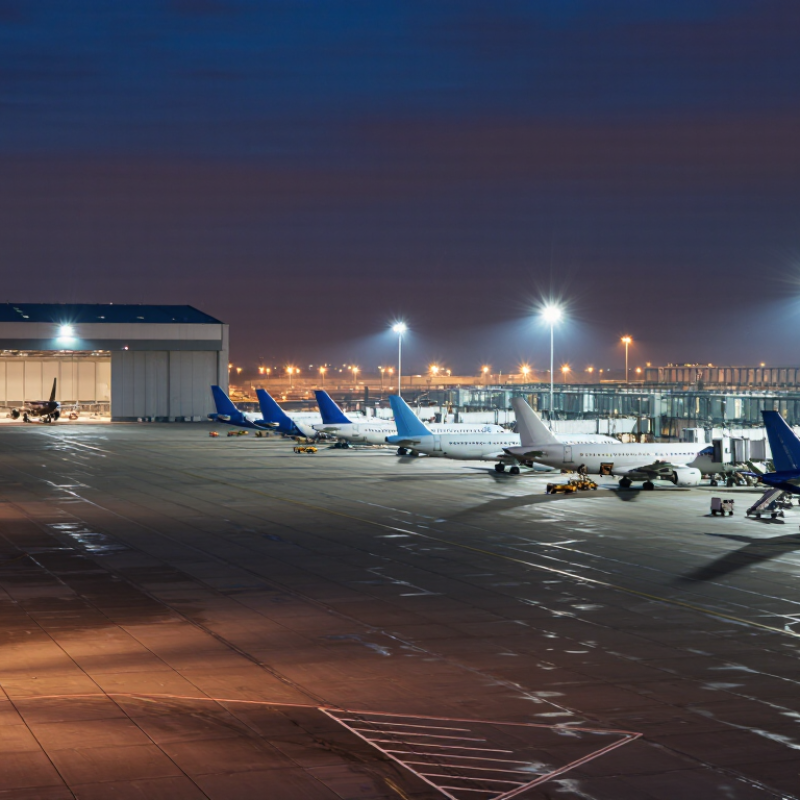
Airport floodlights support safe movement across aprons, taxiways, service roads, hangars, and maintenance zones. They reveal aircraft edges, equipment, spilled fluids, and ground markings during night operations. Their purpose is not simply producing maximum brightness. Excessive glare can hide cockpit signals and reduce a pilot’s visual comfort. ICAO Annex 14 distinguishes floodlighting from runway lighting, which uses controlled visual guidance systems.
Common floodlight types include LED area lights, high-mast projectors, pole-mounted fixtures, and portable units for temporary work. LED systems usually offer precise beam control, instant starting, and lower maintenance demand. A useful design target for apron work is about 20 lux average horizontal illuminance, with careful uniformity control. Local standards must confirm the final value. The U.S. FAA AC 150/5340-30J also stresses photometric performance, aiming, shielding, and installation quality.
Applications differ sharply. Apron lights need wide, even coverage without shining into aircraft windows. High-mast systems suit large stands, while lower poles reduce spill light near terminals. ICAO runway guidance commonly limits runway-edge-light spacing to 60 metres on instrument runways and 100 metres on non-instrument runways. These are not floodlight rules, but they show how exact airport lighting can be. A brighter layout is not always a safer layout. In practice, designers may overvalue lux readings and undervalue glare, shadows, and maintenance access. That weakness deserves review. Sources: ICAO Annex 14, Volume I; FAA AC 150/5340-30J; CIE 150:2017.
Top 10 Airport Flood Lights for Global Buyers? - Airport Flood Light Basics: Purpose, Types, and Key Applications
A practical comparison of common LED flood-light configurations used for airport aprons, stands, service roads, parking areas, cargo zones, and perimeter infrastructure.
| No. | Flood-Light Configuration | Typical Airport Application | Nominal Power | Typical Luminaire Output | Recommended Optical Distribution | CCT / CRI | Protection and Surge Rating | Typical Mounting |
|---|---|---|---|---|---|---|---|---|
| 1 | High-Mast Apron Flood Light | Aircraft parking stands, passenger boarding aprons, and remote stands | 600–1,200 W | 90,000–190,000 lm | Asymmetric medium or wide beam for uniform ground coverage | 4,000–5,000 K CRI ≥70 | IP66; IK08–IK10; 10–20 kV surge protection commonly specified | High mast, typically 20–40 m |
| 2 | Precision Apron Flood Light | Apron lighting where glare control, uniformity, and spill-light limits are critical | 300–800 W | 45,000–125,000 lm | Narrow asymmetric beam with controlled upward light | 4,000–5,000 K CRI ≥70 | IP66; IK08 or higher; external surge protection often added | High mast or elevated apron pole |
| 3 | Wide-Beam Area Flood Light | Cargo aprons, aircraft maintenance yards, and large open service areas | 240–600 W | 36,000–95,000 lm | Wide symmetric beam for broad-area illumination | 4,000–5,000 K CRI ≥70 | IP65–IP66; IK08; 6–10 kV surge protection typical | 10–25 m pole, mast arm, or gantry |
| 4 | Taxiway and Service-Road Flood Light | Airport service roads, emergency access routes, and vehicle circulation areas | 100–300 W | 15,000–48,000 lm | Forward-throw asymmetric beam to reduce glare for drivers | 3,000–4,000 K CRI ≥70 | IP66; IK08; 6–10 kV surge protection typical | 4–12 m pole or roadway bracket |
| 5 | Aircraft Maintenance Hangar Flood Light | Exterior hangar aprons, maintenance bays, and aircraft inspection zones | 200–600 W | 30,000–95,000 lm | Medium beam with high uniformity and low glare | 4,000–5,000 K CRI ≥80 | IP65–IP66; IK08; 6–10 kV surge protection typical | Building façade, truss, or 8–20 m pole |
| 6 | Cargo Terminal Flood Light | Loading docks, freight yards, warehouse approaches, and container handling areas | 150–500 W | 22,000–80,000 lm | Asymmetric medium beam for vertical and horizontal surface visibility | 4,000–5,000 K CRI ≥70 | IP66; IK08; 6–10 kV surge protection typical | Building wall, dock structure, or 8–18 m pole |
| 7 | Passenger and Staff Parking Flood Light | Long-stay parking, employee parking, rental-car areas, and shuttle zones | 80–240 W | 12,000–38,000 lm | Type III, Type IV, or asymmetric area distribution | 3,000–4,000 K CRI ≥70 | IP65–IP66; IK08; 6 kV surge protection typical | 6–12 m pole or wall bracket |
| 8 | Perimeter and Security Flood Light | Airport boundary fencing, restricted zones, gates, and security checkpoints | 50–180 W | 7,000–28,000 lm | Narrow or asymmetric beam for long-distance perimeter coverage | 3,000–4,000 K CRI ≥70 | IP66; IK08; 6–10 kV surge protection typical | 3–10 m pole, fence post, or wall bracket |
| 9 | Helipad and Emergency Operations Flood Light | Emergency response zones, rescue staging areas, and helipad surroundings | 100–300 W | 15,000–48,000 lm | Controlled wide beam with careful glare and spill-light management | 4,000–5,000 K CRI ≥80 | IP66; IK08–IK10; 10 kV surge protection often specified | Mobile tower, pole, or emergency mast |
| 10 | Compact Retrofit Flood Light | Small apron sections, utility buildings, workshops, and localized lighting upgrades | 30–150 W | 4,500–24,000 lm | Narrow, medium, or adjustable beam depending on the retrofit area | 3,000–5,000 K CRI ≥70 | IP65–IP66; IK08; 4–6 kV surge protection typical | Existing wall, bracket, pole, or small mast |

Contact us
Please fill out the enquiry form, and our dedicated team will promptly attend to your request