What Are the Top Types of Monofilament Fishing Nets in 2026?

In 2026, choosing among MONOFILAMENT FISHING NETS means looking beyond price or a product label. Net shape, mesh size, twine diameter, and intended fishing method all affect handling and performance. A fine gill net feels light in the hand; a thicker mesh can better withstand repeated use. But no single design suits every fishery.

The scale of global fishing helps explain why gear choices deserve careful attention. The FAO’s The State of World Fisheries and Aquaculture 2024 reports that global fisheries and aquaculture production reached 223.2 million tonnes in 2022. Capture fisheries contributed 92.3 million tonnes. These figures describe production, not monofilament-net sales or performance. That distinction matters. Industry reports often group fishing gear into broad market categories, so product rankings can vary by source and region.

This guide compares common monofilament net types, including gill nets, trammel nets, cast nets, and compact landing nets. It considers construction, typical use, visibility in water, storage, and maintenance. Actual results depend on local conditions and careful setup. Even experienced users can misjudge mesh or twine from a photograph. Some product descriptions are vague, too. We will flag where evidence is limited and distinguish general guidance from manufacturer claims. Before selecting or using any net, check the rules that apply to your location and fishery.
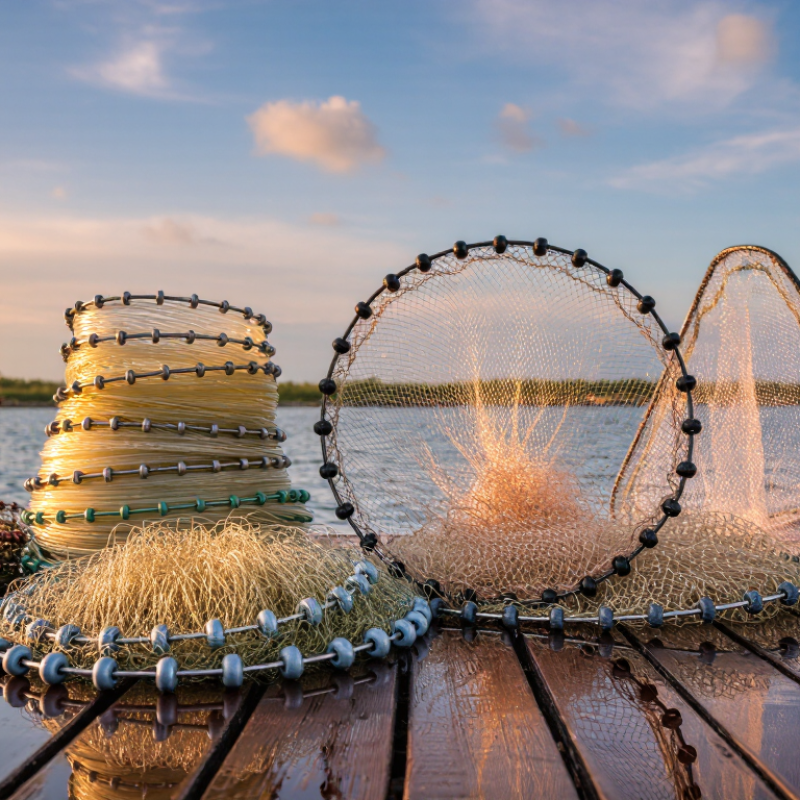
What Are the Top Types of Monofilament Fishing Nets in 2026?

How Monofilament Fishing Nets Are Made and Classified

What Are the Top Types of Monofilament Fishing Nets in 2026?
How Monofilament Fishing Nets Are Made and Classified

Monofilament fishing nets begin as polymer resin, commonly polyamide, melted and pushed through a fine die. The strand cools, then is drawn to improve strength and control its diameter. It may look simple. Small changes matter. Manufacturers check line thickness, tensile behavior, and surface finish before weaving or knotting strands into net panels. Each panel is then measured for mesh opening and shape.

Classification depends on more than material. Nets are also described by twine diameter, mesh size, knot style, depth, and intended fishing method. Gill nets use mesh openings designed to hold fish by the body, while cast nets spread outward from a weighted edge. Knotless nets join strands at intersections without conventional knots. Names and categories can vary, so compare measured specifications rather than relying on labels alone.

Tips: Check mesh size and twine diameter against the task. Feel the net for rough joins or uneven openings. A specification sheet helps, but careful inspection can reveal details it misses.

Gill Nets: Design, Uses, and Common Variations

What Are the Top Types of Monofilament Fishing Nets in 2026?
Gill Nets: Design, Uses, and Common Variations

Gill nets use a vertical wall of mesh to catch fish by the head, gill cover, or body. Monofilament twine is thin and nearly transparent underwater, which can help the net blend into its surroundings. Mesh size, twine thickness, and hanging ratio affect how the net fishes. Small details matter. A poorly matched mesh may catch undersized fish or miss the intended size range.

Common variations include set gill nets anchored in place, drift nets that move with currents, and trammel nets, which use layered mesh to entangle fish. Each design suits different water conditions and target species. FAO’s 2024 State of World Fisheries and Aquaculture reports 92.3 million tonnes of global capture fisheries production in 2022, across all gear types; it does not assign that total to gill nets. That distinction matters when comparing gear claims.

Net handling also deserves attention. Check for torn mesh, secure floats and weights, and retrieve gear carefully to reduce unwanted entanglement. A 2009 FAO/UNEP review estimated annual losses at about 5.7% of fishing nets by number. The estimate is dated, and methods vary, so it is a warning rather than a precise current rate. Even careful crews can miss damage. That is worth reflecting on.

Cast Nets and Seine Nets: Key Differences and Applications

Cast nets and seine nets solve different fishing problems. The FAO’s The State of World Fisheries and Aquaculture 2024 reported 223.2 million tonnes of global fisheries and aquaculture production in 2022. That figure covers many production methods; it does not rank individual net designs. Still, it shows why choosing gear for the site matters.

A cast net is a compact circle with weights around its edge. The operator throws it over visible fish, and the weighted rim sinks to form a pocket. It suits small areas, shallow margins, and targeted throws. Timing matters. Wind, current, and poor visibility can spoil a cast quickly. Monofilament mesh may be less noticeable in clear water, but that advantage varies with light and water conditions.

A seine is a longer wall of netting, usually supported by floats above and weights below. It surrounds or sweeps through a wider area, then is hauled from shore or a vessel. It can be practical for schooling fish in open, unobstructed water, but needs room and coordinated handling. FAO fishing-gear guidance distinguishes surrounding and encircling nets from cast nets by their operation. Mesh size, depth, and local conditions matter more than the label alone. The comparison is useful, not perfect. Check knots and mesh for snags before setting either net.

Trammel Nets and Other Specialized Monofilament Designs

Trammel nets stand out among specialized monofilament designs. They use a fine inner panel between two larger-mesh outer panels. Fish pass through the outer mesh and become pocketed against the inner wall. Monofilament can make the inner panel less visible underwater, but visibility varies with light, water clarity, and line thickness. Small details matter. A practical check is whether the mesh size and hanging ratio suit the target species and fishing ground.

Single-panel monofilament gillnets offer a simpler profile, while tangle nets use slack webbing to catch fish around fins or other body parts. Set and drift versions also differ in how they are deployed and monitored. FAO’s The State of World Fisheries and Aquaculture 2024 reports 223.2 million tonnes of combined fisheries and aquaculture production in 2022. That figure is not a measure of net use; it does show the scale of the wider seafood sector in which gear choices matter.

For buyers and operators, compare twine diameter, mesh opening, knot strength, panel depth, and repairability—not just the net’s stated catch performance. A thinner line may reduce visibility, yet it can be harder to handle and more vulnerable to abrasion on rough bottoms. A tidy specification sheet cannot predict every haul. Local trials and careful checks for wear are still needed.

What Are the Top Types of Monofilament Fishing Nets in 2026? - Trammel Nets and Other Specialized Monofilament Designs

Net type Typical construction How it is used Common applications Key considerations
Trammel net Three panels: a fine-mesh inner panel hung slack between two larger-mesh outer panels. Set on the bottom or in the water column; fish may become pocketed in the loose inner panel. Selected coastal and inland fisheries targeting species suited to entangling gear. More panel layers can increase capture opportunities but also add weight, handling effort, and potential bycatch. Local rules may restrict its use.
Single-panel gillnet One panel of mesh, commonly hung between a floatline and a weighted leadline. Fish are generally caught when they attempt to pass through and become gilled, wedged, or entangled. Species-selective fisheries where mesh size and net placement can be matched to the target catch. Selectivity depends on mesh dimensions, twine, hanging, and fish size. Bycatch and lost-gear risks require careful management.
Set or anchored gillnet A single-panel gillnet secured in a fixed position, often with anchors or stakes. Placed across a fish route or in a selected area and checked according to local practice and regulations. Coastal, estuarine, lake, and river fisheries where fixed placement is permitted. Site conditions, current, depth, soak time, and protected-species rules affect safe and lawful operation.
Drift gillnet A single-panel net supported by floats and allowed to drift, typically with a vessel or other means of control. Moves with water or current rather than being fixed to the seabed. Certain pelagic fisheries, subject to location-specific management rules. Restrictions can apply to net length, area, season, monitoring, and target species; entanglement of non-target wildlife is an important concern.
Trammel–gillnet combination A purpose-designed arrangement combining a slack multi-panel section with single-panel netting; configuration varies by fishery. Uses more than one capture mechanism within a net or net section. Specialized fisheries where different target sizes or behaviors call for varied net construction. The term does not describe one universal design; panel layout and legal status should be confirmed with the relevant fishery authority.
Monofilament cast net A circular net with weighted edges and handlines; monofilament is one available netting material. Thrown to spread over fish, then retrieved by its handline so the weighted perimeter closes inward. Small-scale baitfish or other local fisheries where cast nets are allowed. Suitable mesh, net diameter, and permitted use vary by target species and jurisdiction; monofilament is not the only material used for cast nets.
Monofilament seine net A panel of netting with floatation and weights, configured for surrounding or herding fish. Drawn through or around an area and retrieved to concentrate fish; exact operation depends on seine design. Some small-scale and specialized fisheries; material and design vary widely. A seine is a different capture method from a gillnet or trammel net. Use and dimensions are subject to local rules and habitat conditions.
Fine-mesh monofilament panel net A single-panel net made with relatively fine mesh and lightweight monofilament; exact specifications are fishery-specific. Set or deployed using the method permitted for the fishery, often to target smaller fish. Selected small-fish or sampling applications where fine mesh is lawful and appropriate. Fine mesh can catch small or non-target organisms. Minimum mesh sizes, protected species, and gear restrictions must be checked locally.

Note: “Monofilament” describes the netting twine material, not a single fishing method. Mesh size, twine diameter, hanging ratio, net dimensions, and permitted use vary by species, habitat, and jurisdiction. Check current local regulations before selecting or deploying any fishing net.

How to Compare Net Types by Mesh, Twine, and Fishing Conditions

Monofilament fishing nets are best compared by mesh opening, twine thickness, and the water where they will be used. Fine mesh can suit smaller-bodied fish, while wider mesh is generally chosen for larger targets. Check the mesh measurement method before comparing products; stretched and bar measurements are not interchangeable. A few millimeters can change which fish pass through and how easily the net handles.

Twine matters, too. Thinner monofilament is often less visible in clear water, but may be less resistant to abrasion than heavier twine. In rocky channels or around submerged branches, durability may matter more than low visibility. Current, depth, and the time needed to retrieve and inspect the net also affect the choice.

Keep it practical. A net that is difficult to lift safely may not be a good match for the location. One common mistake is choosing mesh from fish length alone; body depth and shape matter as well. I would recheck that assumption against the intended catch. Compare specifications carefully, test handling in safe conditions, and confirm local rules before use.

Article Source:

Contact us

Please fill out the enquiry form, and our dedicated team will promptly attend to your request