What Are the Top Plastic Gear Types in 2026?
Plastic Gears are no longer limited to quiet, low-load mechanisms. In 2026, designers use them in compact actuators, pumps, office equipment, and automotive systems. The best choice depends on more than shape. Load, speed, noise, moisture, temperature, and lubrication all matter. Small details matter, too: a warm gearbox, a damp housing, or a sharp start-stop cycle can change performance.
This guide compares the leading Plastic Gear types, including spur, helical, bevel, worm, and planetary gears. It also explains how common materials such as acetal and nylon affect wear, stiffness, and dimensional stability. Gear researcher K. Mao has published work on polymer gear design and performance. In paraphrase, a practical lesson from that research is: “Choose the gear form and material for the operating conditions, not in isolation.” That distinction is easy to miss.
There is no universal winner. A spur gear may suit a simple, efficient drive, while a helical gear can run more quietly but create additional axial force. Worm gears offer high reduction in a compact space, yet heat and efficiency deserve careful attention. Planetary systems pack several gears into a small footprint; their assembly is less forgiving. These are useful starting points, not guarantees. Real results depend on geometry, manufacturing quality, load, and testing. Some comparisons remain imperfect, because published data may use different test conditions. The sections ahead help readers compare options with those limitations in view.
What Defines a Plastic Gear and How Are Its Types Classified?
What Are the Top Plastic Gear Types in 2026?
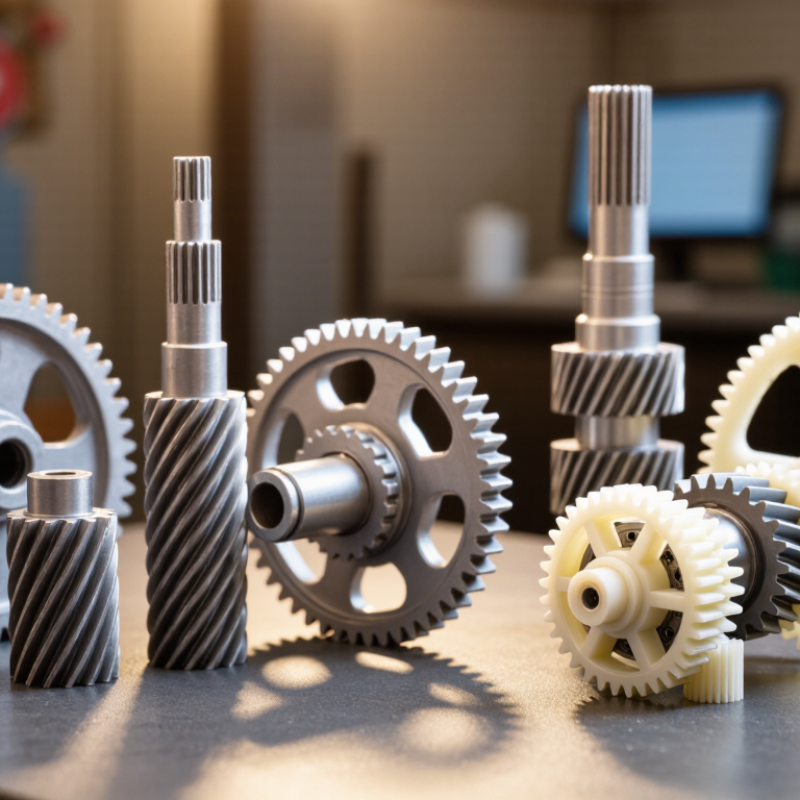
A plastic gear is a toothed machine component that transfers motion and torque through contact with another gear or toothed part. Its defining feature is not simply its material. Tooth geometry, load, speed, temperature, and lubrication all shape its performance. Common gear forms include spur gears, with straight teeth for parallel shafts; helical gears, whose angled teeth engage more gradually; bevel gears for intersecting shafts; and worm gears for right-angle drives with high reduction. Racks convert rotary motion into linear travel. Small details matter.
Material provides another useful classification. Acetal is often selected for dimensional stability and low friction; nylon offers toughness, but can absorb moisture and change size. Higher-temperature polymers may suit demanding conditions, though they can raise cost and machining complexity. PlasticsEurope’s 2024 report, Plastics – the Fast Facts, estimates global plastics production at 413.8 million tonnes in 2023. That figure describes the wider material supply, not gear output, so it should not be read as a measure of gear demand. Manufacturing method also matters: injection molding supports high-volume parts, while machining can suit prototypes or low-volume replacements. A simple taxonomy can mislead. A “helical” gear made from different polymers may behave very differently under heat, impact, or sustained load. Specify the operating conditions before choosing a type.
What Are the Top Plastic Gear Types in 2026?
Plastic gears are toothed components made from engineering thermoplastics. They are commonly classified by resin family, such as acetal (POM), nylon (PA), PEEK, UHMWPE, and polycarbonate (PC).
Ranges show indicative continuous-use temperatures for the base polymer families, not guaranteed gear operating limits. Actual performance depends on grade, load, speed, lubrication, moisture, and gear design.
Spur and Helical Plastic Gears for Parallel-Shaft Applications
What Are the Top Plastic Gear Types in 2026?
Spur and Helical Plastic Gears for Parallel-Shaft Applications
For parallel shafts, spur and helical gears are common choices in compact mechanisms. Spur teeth run straight across the face, making them simple to inspect and efficient at moderate speeds. They engage with a distinct sound, which can matter in small appliances or office equipment. Helical teeth meet gradually, often producing smoother, quieter operation. That smoothness comes with extra axial force, so shaft support and alignment deserve attention.
Material choice affects wear, noise, and service life. Engineering plastics vary in stiffness, moisture response, and heat tolerance; the right option depends on load, speed, and operating temperature. A gear that runs quietly on a test bench may behave differently inside a warm, enclosed housing. Fit matters. Check tooth contact, backlash, and shaft spacing under realistic conditions. I’ve seen small alignment errors create more trouble than the tooth profile itself.
Tips: Match the gear type to the noise target and load profile, not just the price. Keep spur gears in mind when simple, economical transmission is the priority. Consider helical gears where smoother engagement is valuable, while accounting for thrust. Measure twice. Test the assembled drive at its expected temperature, and review wear after a practical run-in period. Some results still surprise.
Bevel and Worm Plastic Gears for Angled and High-Reduction Drives
Bevel and worm gears solve different layout problems in compact drives. Bevel gears transfer motion between intersecting shafts, often at 90 degrees, making them useful in angled actuators and small right-angle gearboxes. Worm sets provide substantial speed reduction in a compact package. A plastic worm wheel running against a metal worm is common, but sliding contact creates heat and wear. Check the actual duty cycle, not just the peak torque.
Material choice matters. Grand View Research’s Engineering Plastics Market report valued the global market at USD 111.0 billion in 2023 and projected 6.8% annual growth through 2030, reflecting wider use of performance polymers. That market figure is not a gear-sales forecast. For design checks, VDI 2736 addresses thermoplastic gear load capacity; engineers should account for temperature, lubrication, moisture, and sustained loading. Heat changes everything. A gear that runs quietly on a short bench test may soften or wear faster under continuous load. Plastic can reduce noise and weight, but it is not automatically a low-maintenance choice. A modest reduction ratio and better cooling may outperform a tightly packed, high-ratio design.
How to Choose a Plastic Gear Type by Load, Material, and Use
What Are the Top Plastic Gear Types in 2026?
How to Choose a Plastic Gear Type by Load, Material, and Use
Start with the motion and load, not the gear catalog. Spur gears suit parallel shafts and simple, compact drives. Helical gears run more smoothly, but their angled teeth create axial force that the supports must handle. Bevel gears redirect motion between intersecting shafts. Worm gears provide large speed reductions in tight spaces, though sliding contact can raise heat and wear. Rack-and-pinion sets convert rotation into straight-line movement. Keep it practical.
Material changes the decision. Acetal often offers low friction and stable dimensions for quiet, moderate-load mechanisms. Nylon can absorb shock, but moisture may change its dimensions. Reinforced plastics can improve stiffness, yet may increase tooth wear on a mating gear. Check operating temperature, lubrication, speed, and chemical exposure against the specific material grade. A gear that feels sturdy by hand may still creep under a steady load.
Consider the actual duty cycle. A small spur gear in a desk device faces different demands from a helical gear running for hours inside a warm enclosure. Look at tooth strength, shaft alignment, backlash, and housing stiffness together; a weak support can spoil a sound gear choice. Prototype under real conditions, then inspect tooth contact and wear. Calculations help, but they cannot capture every molding variation or assembly mistake. That part is easy to underestimate.
